Lipce Cemetery
The PeasantsLipce Cemetery is where the village’s ritual care for the dead meets the buried, often unrecorded injuries of its past. In its annual observances, families gather to pray; among its neglected graves, Kuba recalls the people and violence that shaped his life. The cemetery is therefore more than a setting for religious ceremony: it holds competing forms of memory, from communal prayer to private testimony about lives nearly erased.
A place of annual observance
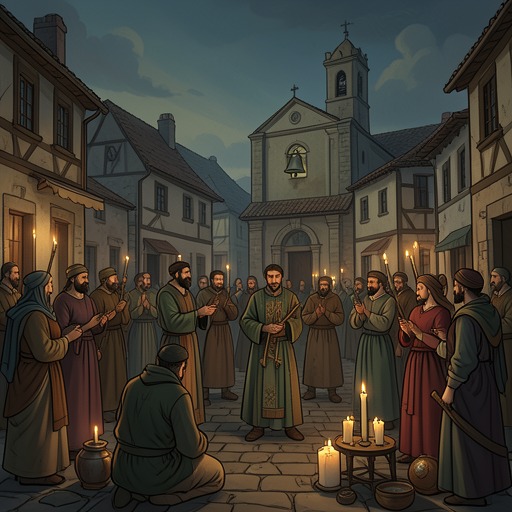
Once a year, vespers are held at the graveyard chapel. People from Boryna’s household come together: Antek with his wife and children, the blacksmith and his family, Józka and Jagustynka, and Kuba arriving on his lame leg with Witek. Their visit makes the cemetery part of a shared calendar of worship, even as the approaching autumn dusk gives the gathering a somber cast.
The observance includes prayers for the dead believed to remain in purgatory. During one service, a coffin stands beneath a catafalque in the church, surrounded by candles, while the priest recites the names of the dead and the congregation answers with prayers. Kuba follows the prayers with Witek beside him; worn out by crying and the warmth of the crowded service, Witek eventually falls asleep against Kuba. The scene places bodily fatigue and intimate care within a public ritual of remembrance.
The forgotten graves
Beyond the formal service lies an older, neglected part of the cemetery. Its sunken graves are overgrown and gloomy; crumbling crosses mark the earth, but whole families, villages, and generations lie there without anyone left to pray, weep, or light a lamp. The contrast is stark: the living perform an annual rite for the dead, while these older burials have slipped beyond the reach of regular remembrance.
Kuba carries bread saved from his own food and breaks it into pieces to scatter over the graves. His gesture gives practical form to the belief that the dead may still need care. It also answers the cemetery’s silence: where no one else remembers these forgotten people, Kuba offers food and prayer. The act makes remembrance an obligation undertaken by an individual, not only a ceremony sustained by the village.
Kuba’s family memory
The cemetery also becomes the place where Kuba tells Witek about his mother’s grave. Witek points toward a light and a figure among the graves; Kuba explains that his kin, including his mother, lie there. Nearby, Ambrozy, Jagustynka, and old Kłąb kneel at the low, nearly erased graves. There are no crosses or trees to mark them, only bare sand, dried stalks, and silence. The scene joins Kuba’s personal recollection to a landscape in which the dead are physically present but scarcely legible.
Kuba remembers his mother, Magdalena, and his father, Pieter, nicknamed Socha. His father owned land but worked as a coachman at the manor; after his death, Kuba’s uncles took the land, and Kuba was left to mind the manor’s pigs. He later drove horses for the squire, hunted for other gentlemen, and received a shotgun from the young squire. These details tie the family’s loss of land to Kuba’s life in service, making his account a history of dispossession as well as kinship.
Kuba then recalls being taken away with the manor party during a period of fighting. He describes carrying the wounded young squire, who was hit in the stomach, and later making his way back on an injured leg through deep snow. On his return he found the manor burned and the old master, the old mistress, his mother, and a maid murdered in the garden. The memory breaks out as grief before Witek, exhausted from crying, falls asleep. The cemetery gives this testimony its setting: the graves are not an abstract reminder of mortality but the place from which Kuba’s losses speak.
Memory within the village’s sacred landscape
Lipce Cemetery holds both the orderly repetitions of religious observance and the irregular fragments of history that prayer cannot restore. The chapel service gathers households around named dead; the unmarked graves expose how easily whole families and generations can disappear from communal memory. Kuba’s bread offering and account of his mother insist on attention to those absences.
The cemetery’s significance also depends on its relation to the living village. During a later church procession, the graveyard grows quiet again after the procession passes and the service resumes, returning worshippers from public movement to prayer and conversation among the graves. Across these scenes, the burial ground is a threshold between collective ritual and private recollection: a place where the dead are commended to religious care, but where the living must also recover the stories that ordinary remembrance has allowed to fade.